Nvidia’s market cap at the top of the charts, startups raising billions before a dollar of profit, one question at every dinner I attend: is this dot-com 2.0? The rhyme is real enough to take seriously. In the late 90s the NASDAQ surged nearly 600 percent on the belief that the “new economy” had abolished old metrics. At the peak the index’s price-to-earnings ratio hit 200. Adding “.com” to a company name was worth 74 percent on the stock price.
Today the echo is audible. Mentioning “AI” on an earnings call adds an average of 4.6 percent to a company’s stock value. The market feels frothy and the transformation narrative sounds familiar. But look past the hype and the economics of this boom run on a different chassis.
- +600% NASDAQ, late 1990s, on the belief that the new economy had abolished old metrics
- 200 Price-to-earnings ratio of the index at the peak
- +74% What adding “.com” to a company name was worth on the stock price
- +4.6% What mentioning “AI” on an earnings call adds today, on average
The critical difference: selling utility, not just a URL
The defining flaw of the dot-com mania was the decoupling of valuation from reality. Companies were celebrated for burning cash, not for creating it. The poster children of the bust:
Pets.com raised $82.5 million in its IPO, then spent $11.8 million on advertising in its first fiscal year to generate $619,000 in revenue. It was liquidated in 268 days.
Webvan, an online grocer, achieved an $8.45 billion market cap on its first day of trading on $395,000 in revenue over the prior six months. It burned through $1.2 billion before collapsing.
The leaders of the AI boom sell something else: functional products that businesses embed into their core operations. The revenue is documented and massive. Nvidia’s Data Center segment, the engine room of the AI buildout, generated over $115 billion in revenue in its 2025 fiscal year. OpenAI reached a reported $13 billion annualized revenue run rate by the end of 2025, selling API access and subscriptions that businesses use today.
Between 92 and 99 percent of Fortune 500 companies are now actively using AI technologies, according to recent reports, and they do so because the return on investment is clear and quantifiable. This is not speculative adoption. It is deep, strategic integration.
The dot-com era sold a vision. The AI era is selling a utility.
New dangers for a new era
None of this means the moment is safe. The risks are different from 1999, not smaller.
The oligopoly and “circular revenue”. The dot-com boom was a chaotic, decentralized gold rush with thousands of competitors. The AI boom is a concentrated oligopoly. The giants are both the primary investors in and the primary customers of the leading labs, a loop some analysts label “circular revenue”. Microsoft commits billions to OpenAI, which uses that capital to buy compute from Microsoft Azure. Nvidia commits billions to OpenAI, OpenAI commits billions to Oracle, Oracle buys billions of dollars of GPUs from Nvidia. The loop can inflate revenues and valuations without reflecting organic market demand.
The billion-dollar burn rate. The capital intensity of AI is orders of magnitude higher than anything in the dot-com era. Training a single frontier model like GPT-4 costs more than $100 million, and future models are expected to pass a billion. Despite its revenue, OpenAI reportedly burned through billions in cash in the first half of 2025. Even with real products and real customers, the path to sustainable profitability is steep and depends on continuous access to massive pools of capital.
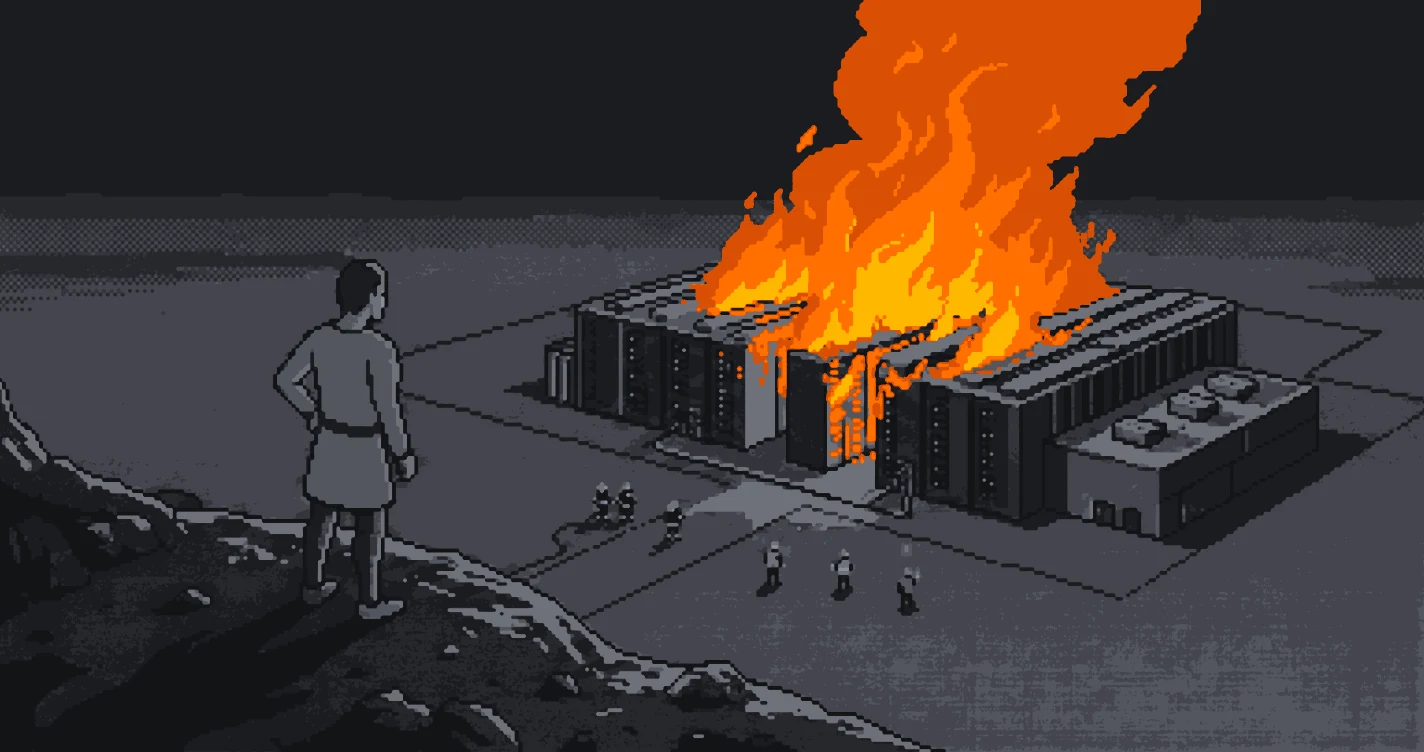
The infrastructure trap. The most sophisticated risk is the legacy this boom leaves behind. The “wasted” capital of the dot-com era produced a glut of cheap, open-standard fiber that enabled the next two decades of internet innovation. The AI infrastructure being built today is a closed ecosystem of proprietary, short-lifespan GPUs, often obsolete within one to three years. If the market turns, these assets cannot be repurposed. The dot-com bust left open highways. An AI bust could leave silent cathedrals of compute, stranded assets with little utility.
The outlook: a correction, not a collapse
The consensus among market-watchers at firms from Goldman Sachs to Morgan Stanley is not a 2001-style apocalypse but a powerful correction and consolidation. A catastrophic crash only happens if the correction triggers failures elsewhere in the economy, in something like an already vulnerable subprime loan market.
When capital tightens, the market separates narrative from necessity. The companies that weather the storm fall into three camps:
- Indispensable infrastructure
- The picks-and-shovels players like Nvidia and the major cloud providers, the bedrock of the ecosystem.
- Diversified incumbents
- Giants like Microsoft, Google and Amazon, whose profitable core businesses absorb losses and buy struggling startups at a discount.
- Unique innovators
- Companies like Anthropic and OpenAI, which hold significant market share with targeted offerings and the revenue to back it up.
For leaders the takeaway is simple. The question is no longer whether AI is a transformative technology. It is. The operative question is which business models built on it are durable. That path from technology to value is the subject of The AI Value Gap.
The dot-com crash was not the end of the internet. It was a violent pruning that cleared the way for Amazon, eBay, and later Google and Facebook, whose models were grounded in sound economics. An AI winter would do the same: a reckoning for those without a defensible position, a validation for those creating measurable value.